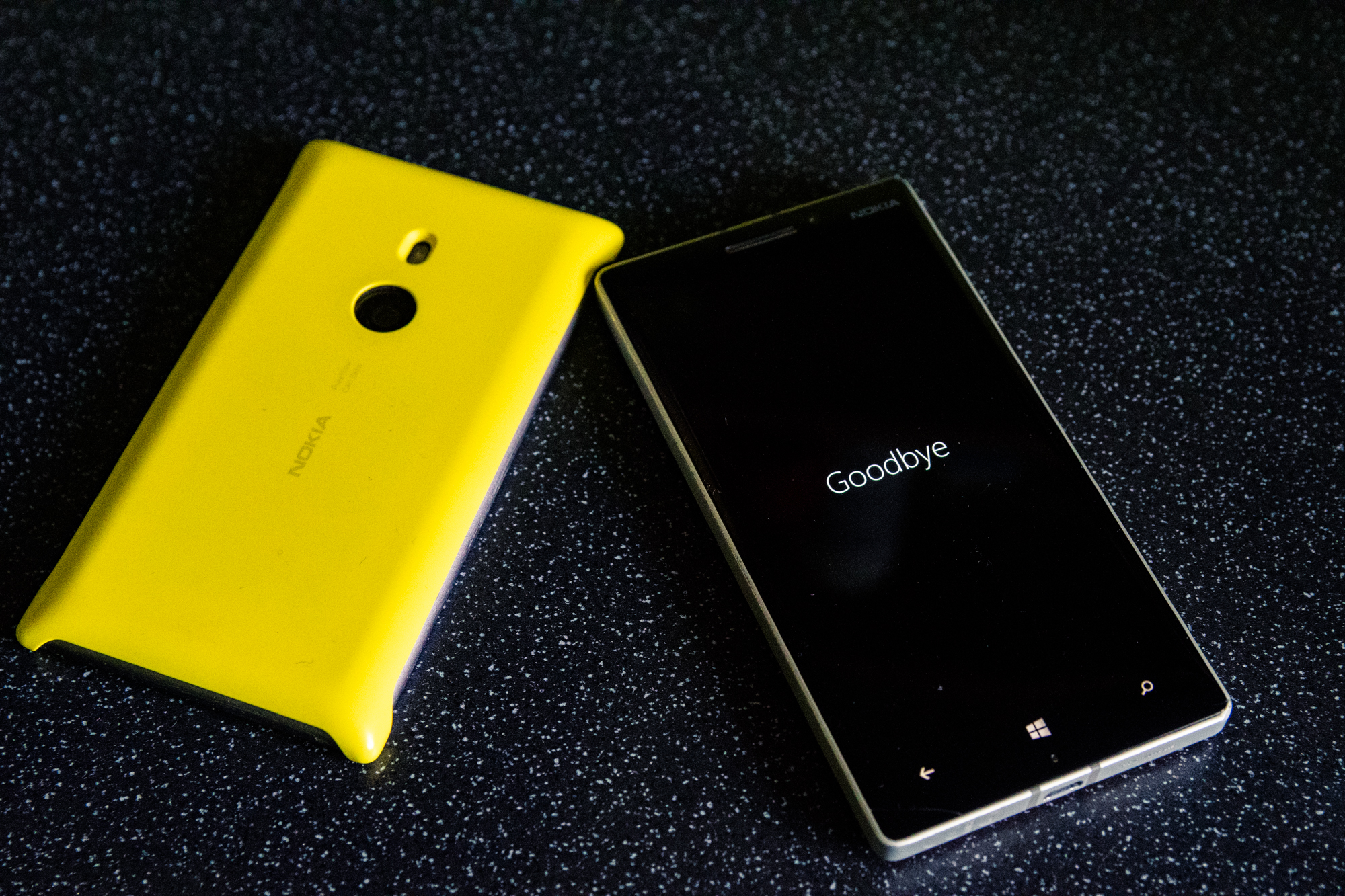
For over five years I have exclusively used Windows Phones as my personal smartphone of choice. Sure, I’ve had exposure to and have used plenty of Android and iOS devices in that time, but I’ve always had Windows Phones for myself and even years and years ago I actually briefly used a MiO DigiWalker A701 with Windows Mobile 5.0 as my primary mobile phone and that was a long time before I had any connections with Microsoft whatsoever! However, with the deprecation of Windows 10 Mobile and Microsoft not really having any strategy of their own in place to develop a new mobile ecosystem (I don’t believe the ‘Surface Phone’ rumours that have been surfacing for over three years now and I remember over a year ago people were saying ‘Windows 10 on ARM is going to change the world’ – where is it?), I’ve decided that is finally time to move on.
The Windows Phones I used as my primary smartphone
Below are the phones I used as my ‘daily driver’ with the operating systems that I used on them (note, they may have also been capable of running another version of Windows Phone).
- Nokia Lumia 710, Windows Phone 7.5 and 7.8, January 2013 – August 2014 (mid-range)
- Nokia Lumia 625, Windows Phone 8.1 and Windows 10 Mobile Beta, August 2014 – November 2015 (low-end)
- Nokia Lumia 925, Windows Phone 8.1 and Windows 10 Mobile Build 10586, November 2015 – May 2016 (flagship)
- Nokia Lumia 930, Windows 10 Mobile Build 10586 and Build 14393, May 2016 – October 2017 and again from December 2017 – April 2018 (flagship)
- Microsoft Lumia 950 XL, Windows 10 Mobile Build 15063, October 2017 – December 2017 (flagship)
I still own all of these devices apart from the 950 XL.

Why am I moving on now? Why didn’t I do it in October 2017 when Microsoft deprecated Windows 10 Mobile?
The simple answer is because my ageing Nokia Lumia 930 is beginning to show its age now – in both software and hardware terms. The software actually still runs OK but unfortunately the latest version of Windows 10 Mobile available for the 930 is Build 14393, also known as the ‘Anniversary Edition’ which was released in July 2016. Unfortunately that means that several core apps such as the Edge browser are also 2 years out of date now which makes running some modern websites slightly challenging now, but third-party apps are still receiving updates. Though I am noticing that they are putting less and less time and effort into their Windows apps which is to be expected as the platform becomes less and less popular.
The hardware in my 930 is still decent enough, but the battery has basically ‘had it’ and my 930 is an early example made out of a poor quality glue so the whole phone is literally beginning to fall apart. The screen is lifting from the body meaning that the proximity sensor is dislodged and so the phone has no idea when it is by your head or not – very annoying when trying to end a call!
I realised back in October when Microsoft announced the death of Windows 10 Mobile that my 930 was on its last legs and I should get something else. On the day Microsoft announced its death, I decided that despite this I actually still liked the OS and didn’t really have the money to buy a high-end Android or iOS handset to replace my 930, so I went onto eBay and got myself a used 950 XL for £240 thinking that I’d be able to use it until 2019 when Microsoft actually end support and updates for Windows 10 Mobile. I thought that by 2019 Microsoft will have either got their act together and make a new mobile OS (seems unlikely!) or I’d have enough money to buy something else by then.
And that 950 XL was probably the worst purchase I made in 2017. Or ever, possibly!
Why did I like Windows Phone?
The MiO running Windows Mobile aside (it was ancient when I was using it anyway), I got my first Windows Phone in January 2013 and I guess I just liked the platform and stuck with it and had Windows Phone after Windows Phone after Windows Phone. I guess these are the things I liked about Windows Phones, especially in the Windows Phone 8 and 8.1 era (2013-2015). I never really had any bad experiences with the platform until I got Windows 10 on my Lumia 930.
The tiles interface
I just felt that it was a stroke of design genius. For me it worked great – I could pin my most used apps to a screen that is always accessible by pressing the Start button. The tiles worked really well on a touchscreen and ‘live tiles’ were, and still are, awesome! I still love being able to look at my Lumia 930 and being able to read my emails in the Outlook tile, see who last messaged me on Facebook Messenger, Instagram and WhatsApp by the picture of the person in the tile and see what the weather is – all without having to open a single app! It’s truly unique!
I didn’t mind the use of tiles on the Start Screens on Windows 8 and 8.1, but the tiles really shone on Windows Phones.

The low-end phones
Back when I started owning Windows Phones, I didn’t have much money at all. The low-end Android phones were, and still are, crap. Made out of cheap plastic, with poor specs and often with suitably poor performance. The low-end Nokia Windows Phones (Nokia basically made all of the Windows Phones out there) were much better-built than many low-end Android handsets and were often just as well-priced, sometimes cheaper. The Lumia 520 was an awesome budget phone and I happily used a cheap Lumia 625 for over a year.

The performance and battery life
This applies more to Windows Phone 7, 8 and 8.1 more than 10 Mobile, but the performance was great! It was so fast and well-optimised and even on those low-end phones it ran really well! I should know: I used a Lumia 710 with Windows Phone 7.8 and a 625 with Windows Phone 8.1 for well over a year quite happily. Performance was not an issue and these phones are still fast! The OS was also well-optimised for batteries too, the battery life was always pretty decent.
Unfortunately, all things said and done, 10 Mobile was a bit of a pig by comparison and didn’t run as quickly and it also drained battery at a rate of knots on those older phones.
The design of the hardware
I just liked the way Windows Phones looked. I liked the ‘square look’ that most of the Nokia Windows Phones had and the flagships were gorgeous – particularly the 925 and the 930. The 900, 920 and 1520 with their polycarbonate felt tough but lacked the ‘quality feel’ that the 925 and 930 had with their aluminium bodies. I own a 925 as well as a 930 and I think both are gorgeous phones, but it has to be said that the 925 is very possibly one of the most beautiful phones ever created. Interestingly, in 2013 and 2014 when the 925 and 930 were the Windows flagships, their build quality was often praised and when compared to the plastic-bodied Samsung Galaxy S4 and S5 handsets that they were rivalling, the build quality was one of the factors that reviewers favoured on the 925 and 930. Starting with the S6, Samsung started to focus much more on build quality giving the S6 a metal body whereas interestingly the 950 (which was the Microsoft rival) featured a plastic body! 925 and 930 owners were not happy with the 950’s plastic body!

I liked the uniqueness too. Sure, you could buy Windows Phones in the typical white and black colour schemes, but for a long time yellow was on offer, as was red, orange, blue and green on select models! No other manufacturer really offers this – and still doesn’t to this day! I loved having my bright yellow 925 at school and I remember losing my bright orange 930 at work once and sending an email round the firm saying something along the lines of : ‘I’ve misplaced my phone – bright orange Nokia 930 – shouldn’t be too hard to miss!’ Brilliant. Sadly, the 950 was officially only available in black or white. I got a black one, but soon put on a blue aftermarket rear cover and it looked great. I missed my brightly coloured phone! People still talk about them to this day!

The cameras
The high-end Nokia Windows Phones like the 1020, 1520, 930 and 950/950 XL had fantastic cameras that could shoot in RAW and act almost as a D-SLR replacement when out and about. I say ‘almost’ because low-light performance was never as good as a D-SLR’s (and no phone will ever match the low-light performance of a good D-SLR like my Nikon D500) and because you’re stuck with one focal length since you don’t want to be using digital zoom! The camera on the 930 is still adequate in most situations for me and the camera on my 950 XL was amazing. The 950 XL’s camera is still being used as a smartphone camera benchmark today – it was that good! In their day the cameras on the 900, 920 and 925 were also praised but these were nothing compared to the cameras on later models – mainly because they cannot shoot in RAW.


What made me go off Windows Phone?
I guess there’s one main thing.
Windows 10 Mobile was a commercial disaster. What was Microsoft thinking?
Windows 10 Mobile is partly to blame for me going off Windows Phones. In fact, thinking about it, every reason I have for moving away from the platform basically stems back to Windows 10 Mobile being a disaster and nothing else. I could write a very, very long blog post outlining the things that annoy me about Windows 10 Mobile, but I’m going to keep things as short and as sweet as possible and list them here.
Windows 10 Mobile’s performance
Let’s talk in terms of speed: Windows 10 Mobile is quick enough on high-end hardware like the 930 and 950, but on older hardware it was a dog. I remember taking my perfectly usable 625 which had 8.1 on it and then installing 10 Mobile on it – and it basically killed the phone. The phone was unbelievably slow. In the end I had to go back to 8.1 and get a faster phone to be able to use 10 Mobile. On my 930 the performance is acceptable but with every update now it is draining the battery faster and becoming slower and slower. Apps like WhatsApp and Facebook Messenger take an age to load, but luckily core Windows apps like Outlook, Edge, Messaging and the phone are quick enough to open.
Windows 10 Mobile’s reliability
I don’t care what people say, Windows Phone 7, 8 and 8.1 never rebooted or crashed as many times as 10 Mobile does. I just don’t know why, but Windows 10 Mobile has an aversion to staying on! I remember when I upgraded to it from 8.1 on my 930 the OS would frequently freeze and randomly reboot – even when the phone was seemingly being responsive and running OK! I had no idea what was going on – then the Anniversary Edition was released and my 930 seemed to run after that. I never experienced anything like this at all on previous versions of Windows Phone. Then when I got my 950 XL I was taken back to ‘reboot mania’ in a flurry of Deja-Vu. More on this later, but quite often I would have my 950 XL just sitting on my desk and one moment it’d be fine, then I’d look away and when I glanced back at it it was rebooting itself. Quite often I’d unlock the phone and it’d inform me that it had rebooted itself so Windows Hello wasn’t available. Great.

Windows 10 UWP apps could have been great, but…
…but third-parties just didn’t get onboard. For a short while there were actually quite a few popular apps that became UWP apps like Facebook, Instagram, Slack and several news apps, but for the most part developers never got onboard with this exciting platform, presumably because they didn’t get it, they were too hard to develop and/or because Windows 10 Mobile’s market share was so low that it didn’t seem to make any sense. By making UWP apps also work on desktops, tablets and any other Windows 10 device you care to mention, I think Microsoft had hoped that developers would have an incentive to make Windows 10 apps despite Windows 10 Mobile’s low market share because these apps would also be compatible with Windows 10, but why bother coding a dedicated app for Windows 10 when a web app or website often works better for desktop users and can be accessed on any operating system?
The Windows 10 UWP apps that did get made were often poorly-made
Take Facebook Messenger for example. It’s a UWP app that for the most part works fine, but as soon as you try to take a picture from inside the app it crashes itself and you’re forced to take the photo using the Windows Camera app instead and send your photo as an attachment. A neat feature made buggy is the worst kind of feature. I remember the Daily Mail app would ramp my 930’s CPU up for some reason and promptly drain about 25% of its battery after reading just a few articles. The Instagram app on mobile uses a stupid low resolution image if you take a photo to post on a story from the app and on desktops it doesn’t allow you to upload anything at all. The WhatsApp app isn’t UWP, but it just runs so slowly. Everything takes forever in it, especially opening the app itself and opening the camera to take a video. The Windows 10 apps, even from the big multinationals like Facebook, are usually just so crap in comparison to the Android and iOS variants and don’t get updated nearly as often.
And it’s been said a million times before, but there aren’t as many available. At first this didn’t bother me but now I want to use mobile banking, get SnapChatting my friends, get discounts for my bus journeys, get discounts at Burger King and so on – but I can’t do that on a Windows Phone.

Microsoft just gives up too easily these days
I recently read a PC World article titled ‘17 technologies that died in 2017‘ – Microsoft technology features fairly heavily! Everything from KiNect to Windows 10 Mobile to Groove Music to various parts of Cortana to the Band smartwatch (OK, that was 2016 but still recent!) and older stuff like support for Windows Vista (OK, that’s probably not a bad thing!), but it just seems like Microsoft comes up with a good idea, gets consumers to buy it for a bit, then just discontinue it. They don’t seem to be able to admit that sometimes the first iteration of a product isn’t amazing and instead of making the successors better, they just give up and introduce another half-baked idea somewhere down the line and repeat the process.
With Windows 10 Mobile, Microsoft first gave up on its user base by announcing a huge long list of Windows Phones that Windows 10 Mobile wouldn’t be compatible with, starting with the likes of the Lumis 925 which ran versions of 10 Mobile up to Build 10586 just fine, I know because I tried it. Then they started discontinuing new versions of 10 Mobile for older phones that were still only a generation or two old at the time, like the Lumia 930 and most other x30 series phones which were only 2 years old when Microsoft stopped producing new versions of 10 Mobile for them. Imagine Apple discontinuing software updates for the iPhone 6 and 7 series today – imagine how well that would go down! Then that left just the 650, 950 and 950 XL as the only supported Lumia models and then these never got replaced and then over Twitter Microsoft eventually announced rather dramatically ‘IT’S DEAD!’ Brilliant way to lose your users – just stop supporting their [still-capable] phones!
Microsoft was planning to somehow make it possible to port iOS and Android apps to Windows 10 Mobile too, but guess what happened! It got discontinued – before it was even completed! This is probably also partly why apps for Windows 10 Mobile never took off. Developers never knew where they stood!

Finally, the ‘Surface Phone’ is a myth
Rumours of a ‘Surface Phone’ which would possibly be something foldable or have a fold-out keyboard (like the Surface tablets) or be some kind of mini 2-in-1 or be a traditional bar-style smartphone with stupid high specs or maybe be wearable/flexible, first started to surface in late 2015… and guess what – where is the Surface Phone? Every time a mobile phone conference comes up there’s always somebody online who says ‘Will the Surface Phone be announced?’ and the answer is always a NO because it’s a MYTH! Why hold out for something when other companies are actually making stuff?

The Lumia 950 XL
The Windows Phone I bought to ‘last me until Microsoft really kill off the platform in 2019 just because I happen to quite like Windows 10 Mobile and/or not sure if I really want to admit defeat.’
I could write pages and pages about this phone, but I think my thoughts on it can be summarised in one paragraph.
Technically, it was the best Windows Phone ever made with specs that were impressive in 2015 when it launched, but quite average today. But to use, it was by far the worst phone I’ve ever had. When it worked it was the best Windows Phone ever, by miles, but despite the fact that this phone was designed for Windows 10 Mobile, no amount of resetting, reinstalling and looking for help online could stop it rebooting every 15 minutes (not an exaggeration) and generally annoying the hell out of me. Eventually it just decided to stop working altogether and I was forced to sell it at a crushing loss since the warranty had obviously expired. I owned it for just over two months – one month of that was spent rebooting or just reinstalling Windows on it.
Did it have a great screen? It was large and it was gorgeous! But most of the time it was displaying the Microsoft boot splash. Did it have a great camera? Hell yes, in fact it still remains one of the best, but it’s hard to use the camera when the phone is stuck in a boot loop.
That’s all you need to know about my Lumia 950 XL.
Sadly, most 950 and 950 XL users will tell you a very similar story.

All things considered what was the best Windows Phone?
It’s a tough one, but having thought about it this is how I’ve broken it down.
- Best looking: Nokia Lumia 925. It’s smaller than the 930, yes, but overall I think it possibly looked better. The 720 was also a gorgeous looking phone but the aluminium design of the 925 puts it ahead.
- Best performing: Microsoft Lumia 950 XL. When it worked it was a joy to use and it was fast, but unfortunately it never worked.
- Best camera: Microsoft Lumia 950 XL. Even though it was half the resolution of the legendary 1020, it was still a superior camera, especially in low-light.
- Best display: Microsoft Lumia 950 XL… again. The 2K display was gorgeous and made up for the plastic body.
- Best to hold: Nokia Lumia 930: A bit bigger and heavier than the dainty 925 but smaller than the enormous 1520 and made out of a mix of aluminium and plastic, it was perfectly weighted and lovely to hold.
- Most ground-breaking: Nokia Lumia 1520. The first Windows Phone to be a ‘phablet’ (at 6.0″ with a 16:9 aspect ratio it’s still one of the largest smartphones ever made and the largest Windows Phone ever made), the first to include wireless charging without the need for an external shell, the first to have 2GB RAM, the first to have a quad-core CPU and the first smartphone in the world to have the ability to shoot photos in RAW with a pre-installed camera app.
- Best budget: Nokia Lumia 830. Looked and felt like the flagship 930 and had the same size display, but 720p rather than 1080p and featured 1GB of RAM instead of 2GB, a 10 MP camera rather than a 20 MP and 16GB storage rather than 32GB, but came in at about half the price too. For the money it was still a very well-specced phone but some Android handsets from the time were better-specced.
- Best truly budget: Microsoft Lumia 435. Coming in at just £50 SIM free it was difficult to beat especially given it ran Windows Phone 8.1 pretty well.
- Best built: the Lumia 900, 920, 1020 and 1520. Those polycarbonate bodies were indestructible but not light.
And the best overall: the Nokia Lumia 930! Why?
- Had similar looks to the gorgeous 925 but felt better in the hand.
- In its day, it was one of the fastest Windows Phone and still continues to run Windows 10 Mobile Build 14393 well enough to this day (admittedly some apps do run a bit on the slow side though)
- The camera is honestly comparable to that of the 950 XL except in low-light where the 950 XL beats it, otherwise it’s very similar. It can shoot RAW out of the box.
- The 5.0″ 1080p display was amazing in its day and although it doesn’t compare to the 950 XL’s 2K panel or other higher resolution displays today, it’s still perfectly acceptable and colours are still bright and vivid enough. 5.0″ was perceived as being large in 2014 but now is average, making the phone usable over a long period of time.
- It’s the most comfortable Windows Phone to hold by a long shot.
- It featured all of the features that the 1520 introduced – essentially it was a ‘shrunken-down’ 1520 in a 925-esque body. 5.0″ was a large size when it was new.
- Although brand new SIM free in July 2014 it cost over £500, by January 2015 it was available for around £300 which made fairly good value at the time.
- After the 950 and 950 XL were announced, 930s could be had for as little as £150 or £200 new which was good.
- It was a sturdy phone but better-looking than the polycarbonate 900, 920, 1020 and 1520.

It’s time to move on
Indeed it is, time to move on to the Samsung Galaxy S8 for me!
Why the S8 and not an iPhone or the S9?
The S8 is a beautiful phone, the way it looks is so appealing to me and is how I think all smartphones going forwards should look. In fact, I feel about the design of the S8 and S9 now how I felt about the design of the 925 and 930 back in 2013/2014.
As far as value for money is concerned, a brand new S8 can be had for around £470 brand new now that the S9 has been released. Truth be told, the S9 isn’t a lot better than the S8 but costs about twice as much, so this makes the S8 a bargain whilst stocks last. Happily, the S7 and even the S6 can still be bought brand new, so I think the S8 will be available to buy brand new for some time yet. I’m planning to buy one in a weeks’ time, so I’m sure I’ll be OK.
A brand new S8 with Samsung’s excellent ‘ClearView’ case that has wireless charging support and allows you to operate basic functions of the phone with the cover over the screen (this is the kind of technical innovation I like!) and their charging mat will set me back around £520 or so. Well, that’s the cost of a new iPhone 6s Plus which is a 3 year old phone! I can have a year-old S8 with those accessories or a 3 year old iPhone for the same kind of money. Tough choice! I do like iPhones and iOS but I can’t believe how expensive old iPhones still are and I wouldn’t really want anything older than a 7 at this point anyway. And the only iPhone that looks like an S8 is the hideously expensive and quite small iPhone X. Even hardcore Apple fanboys are saying that the UX of the iPhone X is somewhat poor though, thanks in no part to that notorious ‘notch’.
The S8 also comes with Samsung’s lovely Samsung Experience 8.5 Android layer that looks gorgeous – better than Windows Phone which is saying something coming from me as I love(d) that tiles interface! I know that other phones like the Huawei Mate 10 Pro and the Google Pixel 2 XL are possibly better than the S8 and maybe cheaper, but I just love that Samsung software and being a UX geek that matters to me! I used to hate what Samsung did to Android until I saw the S8. I think finally they realised that their UI layer was hideous and that stock Android looked a million times better, so they had to make something that resembled that more.

Is it sad saying goodbye to Windows Phone?
Yes, but at the same time it will be nice to get a more modern phone that can run more apps and generally do more. My course requires me to keep up-to-date with technology and trends, so it’s only right that I move away from this now-deprecated platform and onto a platform that people are using. It will make my testing easier and more meaningful as I will be able to test my work on a popular device that runs a popular device and operating system. I will no longer have to keep saying ‘it doesn’t work so well on this 4 year old Lumia 930 – but that’s OK because nobody apart from me has got one anyway!’

Windows Phone has served me very well for over five years, but now it’s time to wave goodbye and get with the most popular mobile phone platform. Windows Phone has now run its cause and is beginning to show its age, especially given that no more feature updates are going to be produced for it anymore.

Image credits
All images are my own, apart from:
Image of the Microsoft Lumia 950 displaying the Windows Hello message – reference: Parmar, M. (2017). How to fix Lumia 950 random reboots. [online] Windowslatest.com. Available at: https://www.windowslatest.com/2017/08/07/fix-lumia-950-random-reboots/ [Accessed 9 Apr. 2018].
Image of the Samsung Galaxy S8 – reference: Segan, S. (2017). Samsung Galaxy S8. [online] PCMag UK. Available at: http://uk.pcmag.com/samsung-galaxy-s8/88608/review/samsung-galaxy-s8 [Accessed 9 Apr. 2018].
Image of the Samsung Galaxy S8 and the Microsoft Lumia 950 XL – reference: Litchfield, S. (2017). Flagship head to head: Samsung Galaxy S8 vs Lumia 950 XL. [online] All About Windows Phone. Available at: http://allaboutwindowsphone.com/features/item/22106_Flagship_head_to_head_Lumia_95.php [Accessed 9 Apr. 2018].
2 Comments on “After 5 years, I am moving away from Windows Phone to Android. Here’s why.”
Comments are closed.