Summer Internship – Vodafone
To protect the identities of those featured in this post, I will be using pseudo names throughout.
Being a student at University is even more difficult than I could have ever predicted, but that’s what makes it so rewarding. It’s tiring, stressful, the ever-looming deadlines frequently keep me awake at night, and when students aren’t even guaranteed a job at the end of it, I used to call my friends in University mad. However, here I am, nearing the end of the second year of my studies and I wouldn’t trade this journey for the world. The connections I make, and the opportunities I take now are some of the most vital in my career because I have invaluable help from one of the top Universities in the country. While representing myself with NUA as the pedestal, I have decided to endeavour to a Summer Internship at Vodafone UK.
While looking for internships, I was struggling to find something that was UX based, reasonably local and for undergraduates. At the beginning of my search, I saw something particularly desirable advertised by Microsoft. For my 3000 word essay earlier this year, I wrote about how user-centred design has helped companies achieve their organisational objectives in the field of healthcare. Even though the piece became rather tedious, I enjoyed researching for it and found a particular interest in UX for the healthcare sector. So naturally, I was jumping with joy to see Microsoft asking for a user experience researcher in the field of healthcare! It couldn’t get more perfect, I thought.
I thought wrong.
Unfortunately, as I read on, I realised it was for students undertaking PhDs, and I would most likely have to be a child prodigy even to be considered; the search continued.
 Microsoft’s advert on Google Jobs
I’d prefer to work in a large company at this stage of my career progression because of the skillset I have already acquired over the years. I have worked for small, middle and large sized companies outside of the tech sector, and have undergone work experience earlier this year at Neontribe, a small local UX agency who mainly do work for charities and small businesses. All of this has amounted to a lot of experience and knowledge in customer-facing roles and interpersonal skills, preparing me for work in a large, fast-paced, high-pressure organisation. This led me to tech-giant websites, and eventually, Vodafone.
Upon arrival to their Students & Graduates page, there is a section that caught my eye. It talks about the types of people they are looking for, and I felt like I ticked all the boxes. Similarly, the thought of being put on a live project straight away is so enthralling and sounds like an opportunity that is perfect for me. I am a very hands-on person and am always looking into the future, wondering what I can do better next time. Being able to apply this to a large-scale setting will discipline me in all the right ways.
 “The future is exciting. Ready?” – Vodafone’s tagline
As I scroll down, I see their opportunities are split into five categories; Technology, HR, Finance, Commercial and Business. Technology is further divided into Software Engineering, Network Engineering, Security and Big Data and Analytics.
 Technology placement/internship advert
Unfortunately, I didn’t see any UX internships. This was disheartening, but I had been looking for so long and this was the closest I had got, so I asked for a little bit of help. My Dad is a Finance Systems Architect at Vodafone HQ in Newbury, so I enquired about who the best person to e-mail would be. He had a look through the employee e-mail list for Vodafone’s UX network and found a man called Andrew. He is the Head of Digital Experience for UX and Content Design is Vodafone’s UX Chapter in Smale House, London.
My Dad sent him an e-mail first asking about internship opportunities at Vodafone over the Summer. There isn’t anything posted online, so we used the “if you don’t ask, you don’t get” mentality. He asked in which office the internship might take place so we could factor in accommodation and travel expenses to see if this was a viable option. My Dad has a flat in Newbury, so it would be easier to be stationed there for three months, but London would also be a fantastic adventure. He explained how I am very resourceful and “have a knack for just figuring these things out”. He also asked permission for his e-mail address to be passed on to me because the e-mail address was found on the company’s intranet and there are privacy restrictions related to giving out company e-mail addresses without consent.
A few days later, Andrew replied and said he would like to explore the opportunity to take me on over the Summer. In reply to my Dad’s e-mail, he asked for me to forward him my CV and explained that Newbury only has a small team so to get the most out of my time there, I should seriously consider being in London office. I was thrilled! I became very excited very fast and started shopping for new outfits straight away! Only kidding, the first thing I did was, reply to Andrew’s e-mail thanking him for getting back to me, give him a copy of my CV and a link to my LinkedIn profile and confirming that I would like to be placed in their London office… And then I had a browse online.
 My first e-mail correspondence with Andrew
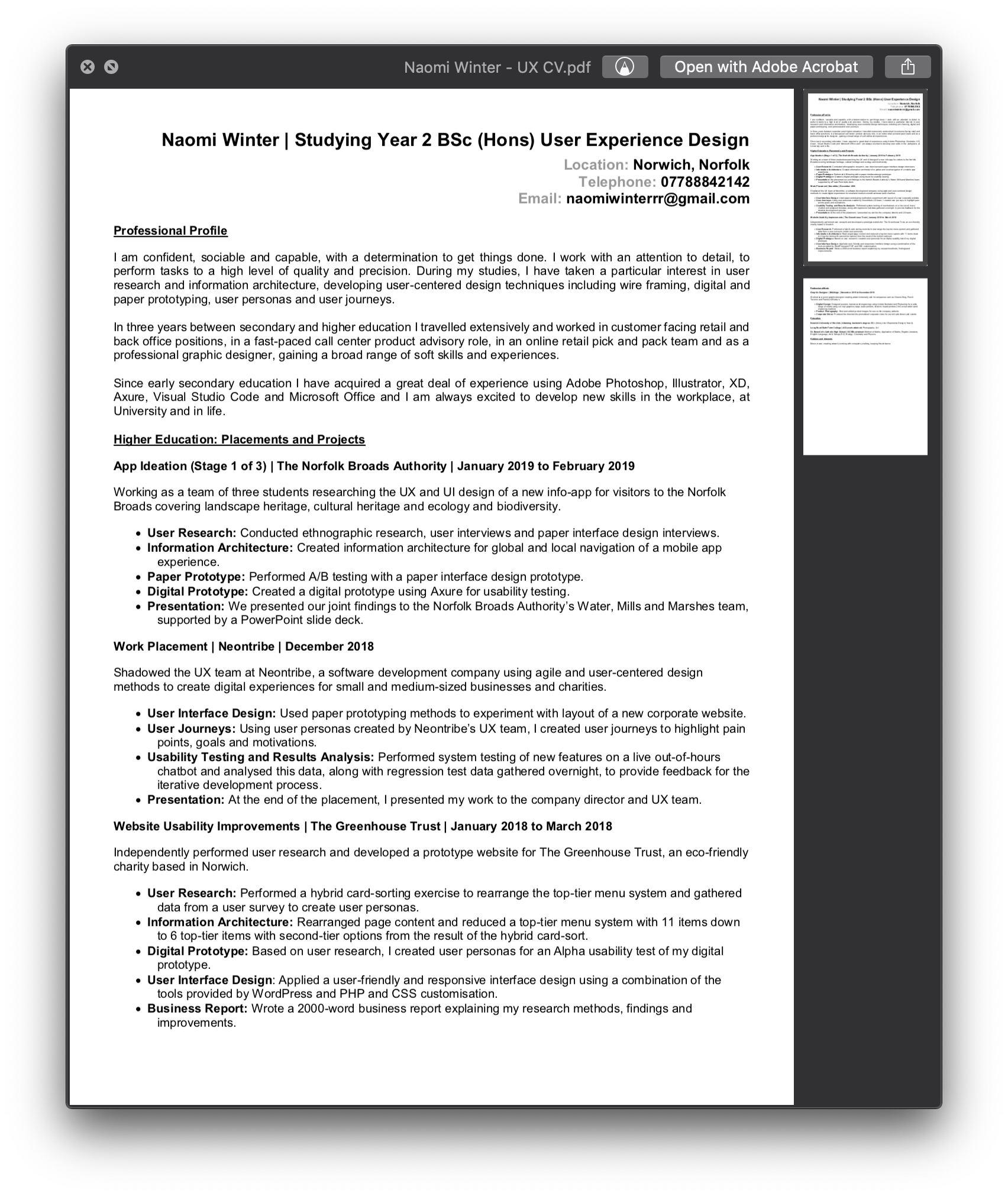
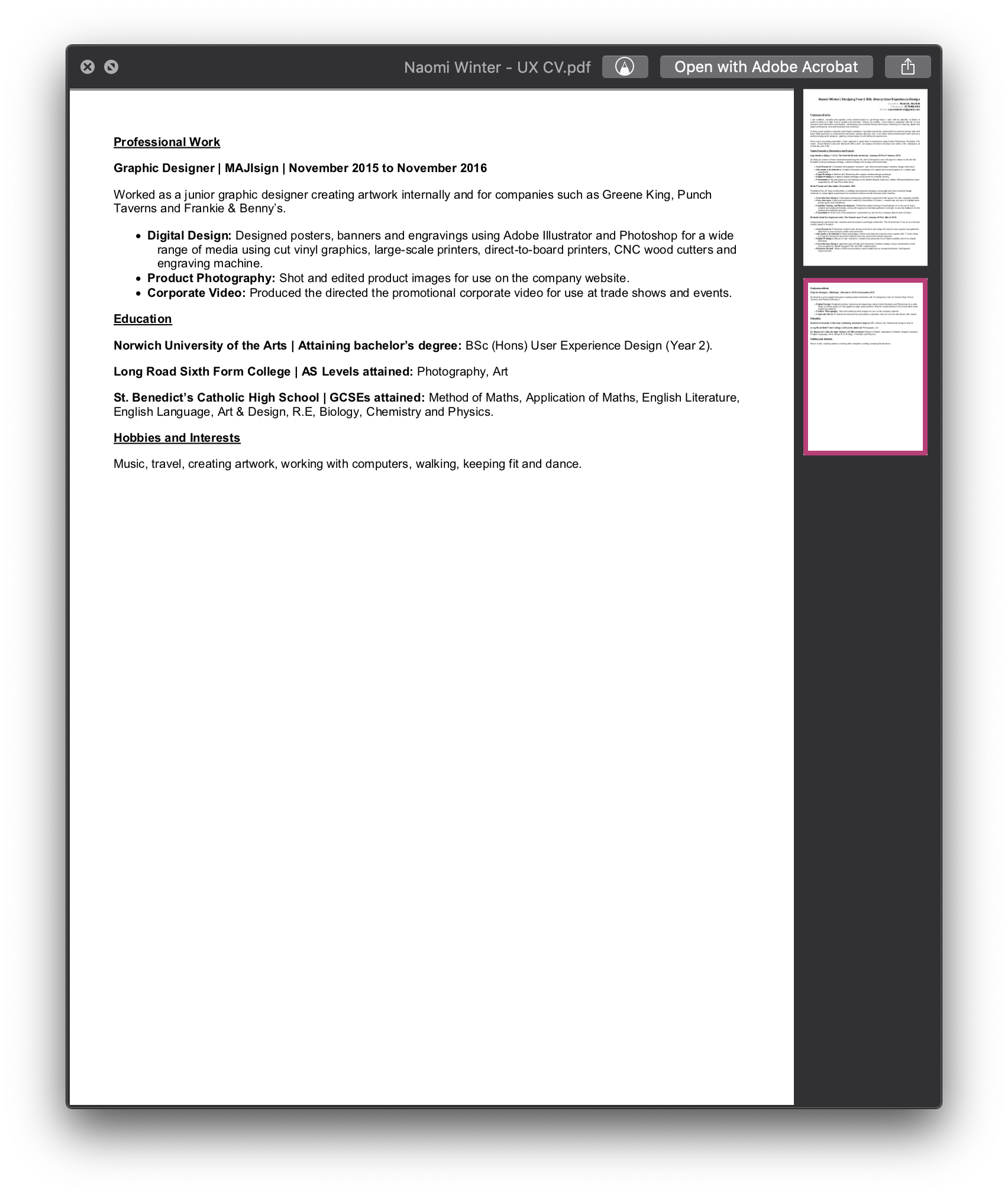
My CV
The next step was to finalise the amount of time I was going to spend there. If I’m going to be based in London, I want to make it worth my while, so I requested a full 12-week placement as per their other internships opportunities. Andrew agreed to my proposed dates of 17th June to 6th September. This gives me just over a months break after my hand-in to relax and mentally prepare myself or The Big Smoke as well as a few weeks afterwards to get myself back into a University mindset.
The final piece of the puzzle was to address the monetary side of the operation. We all know how expensive living costs in London are, coupled this with the fact that I will still be paying rent on my house in Norwich over the Summer, I need to be earning. I was feeling nervous about asking and was writing out e-mail after e-mail, constantly rewording the text because I have never had to write such an e-mail before. However, to my surprise, I didn’t even have to bring it up. Within the e-mail to confirm my position had been approved by HR, he explained that I would be brought on as a contractor and be on an approximate rate of £90 a day; this will certainly cover the cost of fish and chips on a Friday night.
 The confirmation e-mail from Andrew
I was absolutely over the moon. I felt like it was my birthday, Christmas and New Years (all my favourite holidays) all at once and I was so proud of what I had achieved. A paid 12-week internship at one of the world’s leading telecommunications companies in the world.
My future is exciting. I’m ready.
To get the best out of my time at Vodafone, I have broken my main objectives into three categories. These are things that I’m excited about and looking forward to, things I am nervous about and will try to conquer and things I want to learn about the industry and myself.
What I’m Excited For
- Being in London: One of the most exciting things about this opportunity is being able to experience London in all its glory. I worked at my friend’s company on Great Portland Street for a few weeks last Summer, have casually visited, been to the theatre along with other generally touristy things, but have never been left to my own devices. Moving to Norwich from a small Suffolk town was a significant change for me, but I feel as though that, along with my travelling adventures, have adequately prepared me for it.
- A big company: Since I started working when I was a teenager, I have worked at for a range of different sized companies. From volunteering at a small café to working in a call centre for a globally recognised brand, I have my fair share of stories and experiences. Having said this, I have never worked for a true global leader, so I am excited to see first hand what is it like to work in a company with over 100,000 employees.
What I’m Nervous About
- Personalised attention: while trying not to sound ridiculous, I am feeling anxious about not having enough individualised care. I am worried that if it gets too much and I don’t know what to do or who to speak to, I will get lost in the ether of the mass of employees going about their daily routine. I hope I have a structure to my days and weeks with tasks to complete and projects to be thinking about so I don’t have that awkward first day feeling for longer than necessary.
- Not enough industry knowledge: I’m not sure how much they expect me to know about the telecommunications sector before I join, so this is difficult to plan for. I am thinking of asking Andrew if I can prepare in any way, but I want to get the last part of University out of the way before I take any more on. I understand that Vodafone is heavily involved with IoT product development as well which I am particularly interested in, so that eases my nerves.
What I Want to Learn
- Information architecture: UX design is a broad term encompassing a wide range of disciplines. As mentioned time and time again in my blog posts, I am particularly interested in IA, so I would like to bring this up with them and see if I can have some specific guidance in this field.
- Real-life teams: I am desperate to learn what it is like to work within a production team with designers, architects, developers and programmers who are all experts at their craft. Our University groups have been tiny up until the collaboration unit, and even then we did not elect a team leader, we all took turns to delegate tasks around.
Bibliography
Vodafone.co.uk. (2018). Intern Programme | Vodafone.co.uk. [online] Available at: https://careers.vodafone.co.uk/intern-programme [Accessed 10 April 2019].
S.W.O.T. Analysis
To indulge in some self-reflection and asses my skills and abilities as a person and a UX designer wanting to go into a fast-paced and collaborative industry, I have performed a S.W.O.T analysis of myself.
“When we understand the strenghts and weaknesses we bring to the group, we can gain greater appreciation for these qualities in others.” (Brause 2017)
It is designed to help one realise where they thrive and can improve, bettering their chances in their field of practice. We have also used this type of analysis in Stage 1 of the Norfolk Broads project to look at the motivations of a user persona.
 My S.W.O.T analysis
For as long as I can remember, I have said that I would hate to go freelance. I don’t like the idea of creating a schedule for myself as I would much rather go into work Monday-Friday 9-5. I still stand by this, but after doing this exercise, I see my potential as a contractor. I understand that the principle is much the same whereby I would go out and find work myself and have to record my hours, but being employed through a company at the same time is appealing to me. This would be achievable by either starting my own limited company or working through my parent’s and one day takes it over.
The options are there, so I am not worried about that for now. At this moment, I’m happy completing my degree and taking each opportunity as it comes.
Bibliography
Brause, C. (2017). The Designer’s Field Guide to Collaboration. New York: Routledge, Taylor & Francis Group, p.115-117.