User personas and user journeys are something that I have touched on very briefly in the past, firstly in my user journey article published in October and secondly in my ‘Designing for Function’ project, completed in November. It’s been a few months since I last thought about them and with the advent of the second unit of my User Experience Design course approaching which features a new project that almost solely relies on having great user research in order to produce a working product for a client, I thought it would be a good idea to focus on these again.
In short…
- A user persona is fictional representation of an ideal user (or ‘customer’) of your app or website. These are usually created after extensive user research has been done to help make the personas appear more genuine and detailed so that they are more useful for usability testing.
- A user journey is the journey that a user takes using your app or website. A journey encompasses everything from the screens that the user sees, the buttons they press to move through the app and also the ‘pain points’ that they experience whilst using the app.
- A pain point is a feature that will upset, annoy or confuse a user whilst using your app or website. It could be anything from poor wording to a confusing form to a bad choice of colours or something that triggers a negative emotion in the user.
Visit from Harry Harrold and Rupert Redington from NEONTRIBE
Harry Harrold and Rupert Redington work at local UX firm, NEONTRIBE and very kindly volunteered to visit the university on Tuesday January 16th 2018 to deliver a presentation and several practical exercises on the importance of user personas, user journeys and pain points. The information that they communicated in this presentation will be very helpful for my upcoming project which does involve a lot of user research and defining target audiences. Their current project is the Mind of My Own (MOMO) website which allows teenagers and young adults with mental health issues to anonymously contact professionals for help. I feel that this is an extremely noble product and one that can genuinely change lives for the better if executed and supported correctly. It’s saddening to see how many young people suffer from mental health issues these days and with funding being short, private firms are going to have to do more to help tackle the issue.
User personas
The presentation started off by talking about user personas. They explained that the use of user personas does not replace the need for usability testing, but once you have defined the target audience of your product you can create user personas which are fictitious characters but have been highly-developed to the point where they have a full personality and background history. There are so many things to consider when defining a user personas: personality, background history, interests, hobbies, educational/job status on top of the obvious name, age and sex. In these categories, details such as what their childhood was like, what their school-life was like, what kind of technology they use, how they pay for the technology, what position they hold in their job, what they’ve done to try and resolve any unhappiness in their lives and more must all be defined in order to create a comprehensive profile. It was also explained to us that just like our designs, it is a great idea to iterate user personas and improve them and add details as the project goes on.
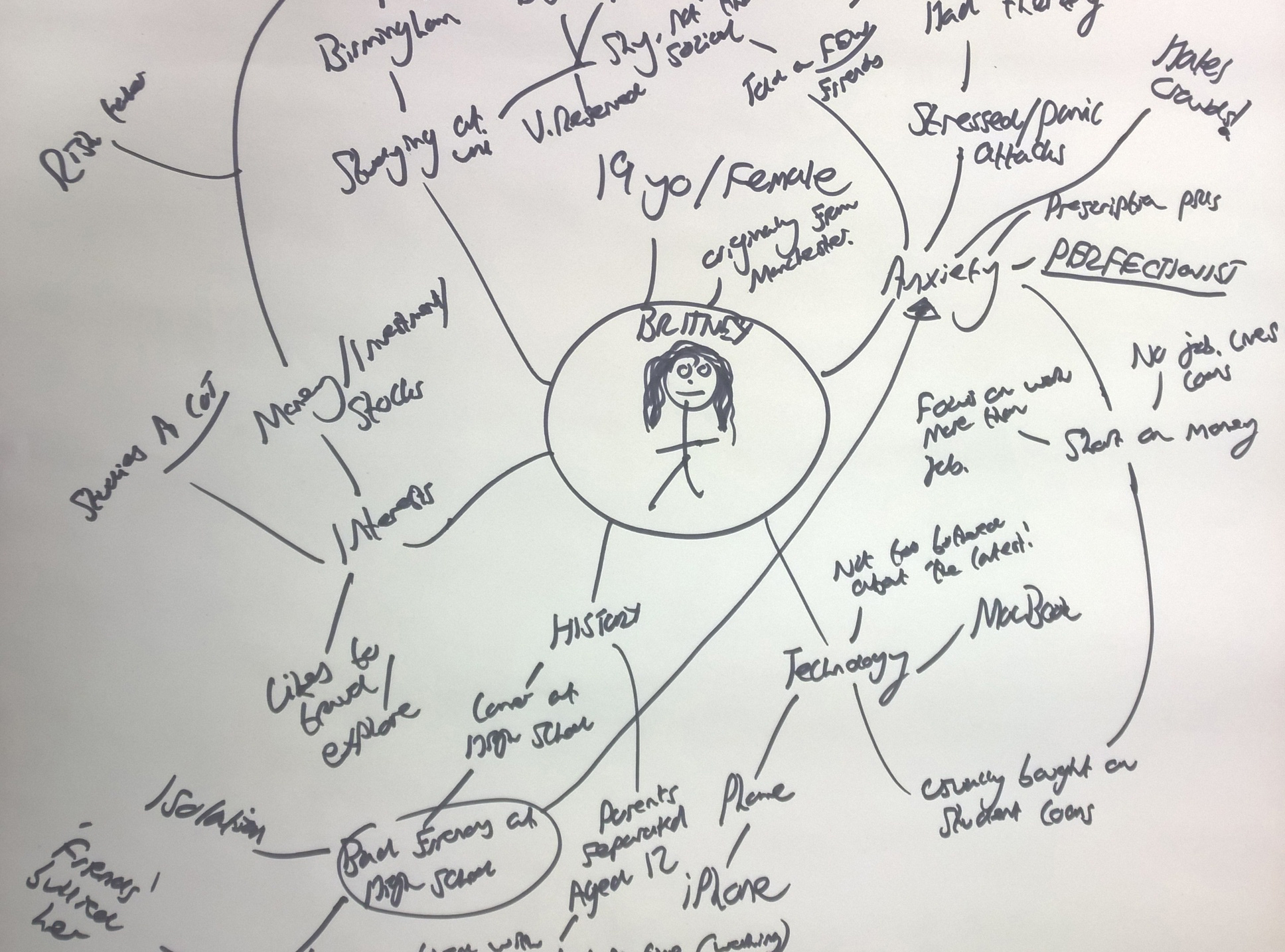
Harry and Rupert put us into two groups of two and tasked each group to create a user persona. Initially, we were given 15 minutes to produce a persona for a teenager experiencing mental health problems (related to the product that NEONTRIBE are working on at the moment) by using a spider diagram to map out their personality traits and background. My peer Ameer and I created a persona for a 19 year old girl called Britney who studies Business & Finance at Birmingham University (originally she is from Manchester) but suffers from anxiety which stems from having poor relations with friends at high school and her parents’ divorce when she was 12. Bullying from peers at school and her very busy dad becoming her primary carer made her feel lonely and isolated and she hasn’t really recovered from it. She doesn’t have a job and uses her student loan to purchase high-end smartphones and laptops but worries that she is not spending her money wisely. She is well-informed and bright, so it was expected that she should go to university, but she knows that if she does not study and focus her free time at her studies and interest in business, she may quickly fall into depression. As a result of this, she studies a lot and rarely goes out and socialises, but despite being a studious and reserved person she is willing to meet new people if introduced to them by others. She wanted to study in Birmingham to try and meet new people and get away from the bad memories of her childhood and high school years in Manchester, but in Birmingham she has new issues. In Manchester her parents’ divorce and lack of friends made her feel isolated, but being so studious and hard-working in Birmingham now means that her anxiety is more a result of being pressured, stressed, worried about money and a perfectionist more so than feeling isolated. She’s never liked talking to people about her anxiety but has confided in a few of her closest friends at university. They have suggested she undertake therapy which she has done, but whilst it has helped a little, it has not fully resolved her anxiety.
All of this, and more information, is shown in the hand-drawn spider diagram below.

This persona was created by Ameer and I in about 15 minutes and is not completely based on anybody we know of at all (i.e., it’s not a perfect description of a real person that we know), though it does have characteristics of lots of different people that we know of, some of whom have or had anxiety a little like the persona’s. In fact, Harry and Rupert were very firm in telling us that to prevent possible bullying and to stop people creating personas that fits their personal agenda for the software, personas should not be based on real people and should also be kept classified. Since this persona is not for a real application that I am creating, I can publish the details of the persona, but usually it would be kept secret. To find out if a user persona has been based on a real person, the creator of the persona is often questioned quite heavily about details of the character, such as details about their school life. If the creator gives answers without much thought or hesitation, it can usually be assumed that the persona is based on a real user and if the creator takes some time to think, it can usually be assumed that the persona is not based on a real person.
User scenarios
After the persona had been created, Harry and Rupert introduced us to ‘scenarios’. These are just examples of where or how an app might be used, for example ‘on the bus’, ‘in the park’, ‘on the sofa’, ‘on a smartphone’, ‘on a desktop computer’ and ‘at school’ could all be scenarios. The idea of scenarios is that you can pair them with a user persona in order to create a solution.

Persona + Scenario = Idea. The idea is the app that can help the persona achieve a goal in a certain scenario. For example, our persona called ‘Britney’ might need an app to use on her smartphone whilst at home to help cure her anxiety. So, Britney + smartphone use + home use = app to fit Britney’s needs.
The idea in this example is the MOMO app produced by NEONTRIBE that allows teenagers and young adults to seek help for mental health issues.
Identifying scenarios helps you to understand what the persona needs from an app and can help you complete the next task.
User journeys
With the persona created, we moved onto user journeys and identifying pain points. The user journey is the ‘journey’ that the user takes using the app or website, showing the pages that they go through and the outcomes that are produced. The pain points are features of the individual pages that may irritate, upset, disturb, anger, confuse or generally annoy the user persona. Identifying them requires thinking empathetically as if you were the user persona to identify annoyances. Pain points can be anything from complicated interfaces to poor wording that makes the user wonder if the page is the right one to be on to colours, images or themes that may make them think bad thoughts or remember past events to just anything that generally confuses or annoys them. Using the different log in pages of the MOMO app developed by NEONTRIBE, we were tasked with identifying the pain points which are shown in the image below on the sticky notes.

Pain points
Thinking of potential failings of a user experience through the eyes of a persona was a challenge that I found quite difficult. A lot of my friends who study Graphic Communication, including Emma whom I am working on Inspix with, tend to be able to think quite deeply about the meaning of elements of graphic design, such as what a logo might speak to a viewer or the meaning behind different shades of colour and the meaning of wording. I tend to be able to read between lines quite well and understand wording and language, however I am not as good at trying to decipher the meaning of a logo or give a very detailed response as to why a certain shade of red might have been used on a website. I often lack the empathy and ability to think deep enough to really think about how somebody else may view a product on a detailed level – especially when the end user is nothing like myself like in this case. As I thought more and more about it and whilst I was writing this article collating my thoughts (or rather, Britney’s) I felt I improved at it, but it didn’t come naturally to me straight away.
Ameer and I were able to note a few pain points that our persona, Britney, may experience in her journey of using the app. Firstly, on the landing page there were three buttons:
- Log in
- Sign up
- Worker’s and carers’ area
These buttons were underneath some introductory text which read something along the lines of: ‘Does anybody listen to you? Honestly? Mind Of My Own is a place for you to be heard’. We first noted that Britney may not read the introductory text fully because by reading ‘Does anybody listen to you?’ she may get saddened if she takes this a rhetorical question and answers ‘no’ in her head. We also noted that the use of ‘Workers’ and carers’ area’ on the button text may make her wonder if she has landed on the right page. She’s not a worker – she is unemployed, and she is not carer? But should she be a carer? Should she have kept care of her parents more during their divorce or should she have seeked a carer to take care of her when she was going through tough times at high school?
MOMO’s logo is a black lightning bolt. Britney has some low-level depression so the black colour of the logo wouldn’t instill her with confidence that this is a service that is meant to uplift and relieve her of her problems and although she doesn’t have a history of cutting herself (and now she is slowly getting over her anxiety she is far less likely to do this or have suicidal thoughts now than she would have done a few years ago whilst she was in high school), could the logo like a little like a blade or a piece of broken glass?
The following page was a form that asks the users to fill in details such as their name, age and location. A user like Bethany who does not suffer greatly from mental illness would probably be OK with giving this information. She is also bright so she would understand why MOMO needs this data, but a user who is more insecure or has had personal data stolen and posted online in the past may not feel comfortable about giving this amount of data to an anonymous source. The problem for Britney is that she believes she lives in two cities: Birmingham and Manchester. Which option does she choose? She thinks she lives in Birmingham because that’s where she studies and is living at the moment, but she comes from Manchester and has to go and live at home for half of the year when her course at university isn’t running. What if she tells them she lives in Birmingham but by the time MOMO has offered her help she may be back in Manchester for the summer.
The page after this was a page that had a single drop-down list on it: asking the user for their local authority area. At this point several things are irritating Britney a little. Firstly, she can’t get over how drab the site looks. It’s a white form on a grey background with black text and very few colours. The colours do not inspire Britney to be happy or reassured that she is being taken care of, instead they are making her tired and a little bored of completing the form. The other thing is that she now wonders why there is a separate page for this single lowly option box? She’s a bit surprised when she reads the caption above it which says ‘Where in the world are you?’ – it makes her feel that MOMO is a global organisation who potentially help millions (or even a few billion?) like herself all across the planet, so she starts to wonder how they can possibly have time for her when there are millions of others to help, who are probably all in need of much more help than she is. She clicks on the drop-down list anyway and is relieved to see that only countries in the United Kingdom are listed, but still wonders why this couldn’t have been asked on the previous page and surely the people at MOMO must know that Birmingham is in England? She’s a busy girl with a lot of work to do (and she needs to do well at this particular piece she is working on since it counts a lot towards her final grade) and she is getting frustrated that it takes so long to fill in the form. ‘Why is there a separate page to find out if you live in England, Scotland, Wales or Northern Ireland when it should be obvious from my location on the previous page?’ she is asking herself. But, she knows that she needs to get this anxiety issue sorted out once and for all, so she continues.
The final screen we evaluated was the screen that allows the user to tell MOMO what kind of help they want and write a description about their issues.
At first Britney takes a few minutes to answer the question about what help she wants. She doesn’t really know what she wants. Does she need counselling? Does she need extra therapy? Does she need some kind of medication? Or does she just need somebody to talk to, hug her, and tell her everything is going to be OK? She begin to wonder at this point if she is just being a ‘teenage girl’ – perhaps a little over-emotional, worrying about things that do not matter, things that she cannot control – or whether there is a genuine problem with her that is worth the time of healthcare professionals to resolve? Is worrying over university work a big deal? Big enough to tell a mental health professional about? What if they look at my request and just laugh it off – just say ‘toughen up, love!’? What if that happens? Will they actually be able to resolve my issue? It doesn’t say that any issue is not an issue when you tell us, so what if my issue isn’t that important? Is this some kind of reverse-psychology to make me realise that I’m actually alright?
At this stage, she decides enough is enough and she is just being a ‘teenager’. She closes the app and continues to work on her latest university assignment. She will feel fine whilst she is studying for this assignment and writing it, but as soon as it’s done and there’s a short break before the next one is given to her, she will be back to square one.
Conclusion
That’s an example of how deep you can get with the pain points and the user personas in general. As can be seen, they can get incredibly detailed very quickly and can really begin to flag up issues with the usability of an app without having to interview a real person. However, a user persona cannot be used in place of real-world testing since a user persona has pre-defined qualities, whereas ideally a tester has no bias whatsoever.
The workshop was extremely-well delivered and very informative. It was a great session and the eccentric nature of Harry’s and Rupert’s personalities made the session even more enjoyable.
2 Comments on “What are user personas, ‘pain points’ and user journeys?”